 EN
EN TR
TR


Mitsui O.S.K. Lines, Ltd announced on 24th of September that it has conducted an environmental assessment of cooling water discharged from Ocean Thermal Energy Conversion (OTEC) as a joint research project with National University Corporation, the University of Tokyo, National University Corporation University of the Ryukyu, and the National Research and Development Agency Japan Science and Technology Agency.
This assessment applied a new system for observing coral distribution and seafloor topography, along with an AI model for estimating coral cover. The technical paper outlining these findings was published in The International Journal of Applied Earth Observation and Geoinformation. This initiative aims to ensure the appropriate management of cold wastewater generated by the OTEC and Deep-Ocean Water projects MOL is promoting. To support this initiative, MOL established an independent review committee and has been conducting literature reviews, regulatory investigations, coral distribution surveys, and cooling water dispersion simulations since fiscal year 2024.
Deep ocean water is characterized by high nutrient content, exceptional purity, and stable low temperatures, making it a promising resource for diverse applications including OTEC, aquaculture, agriculture, and air conditioning. To enable the large-scale use of deep ocean water, it is essential to objectively assess and address the environmental impact of the resulting cold discharge water on marine ecosystems.
In this joint research, a highly efficient seafloor survey tool called the "Speedy Sea Scanner" (Figure 1; jointly developed by the University of Tokyo and Windy Network Co., Ltd.), and "Coral-Lab" a newly developed segmentation model, enabled fully automated coral reef identification and coral cover calculation across a wide survey area (Figure 2).
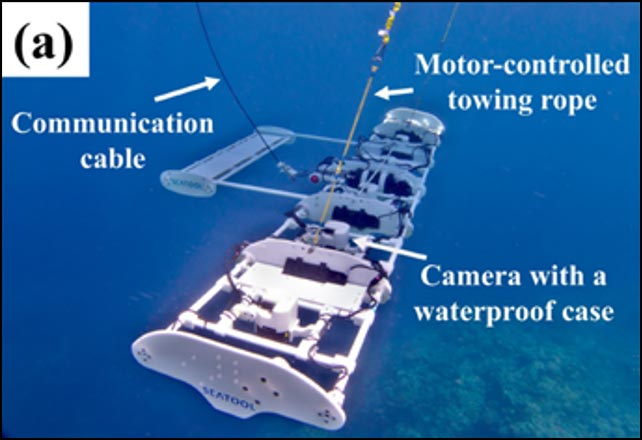 (a) Being towed by a research vessel using a towing rope.
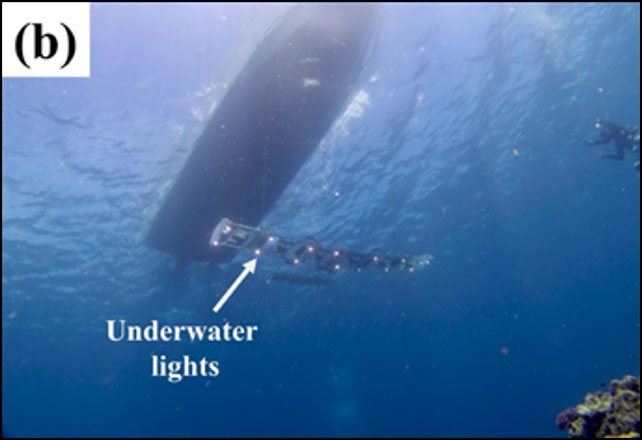 (b) Seen from underneath.
Figure 2: The coral distribution map, estimated by Coral-Lab; Coral coverage is visualized by color
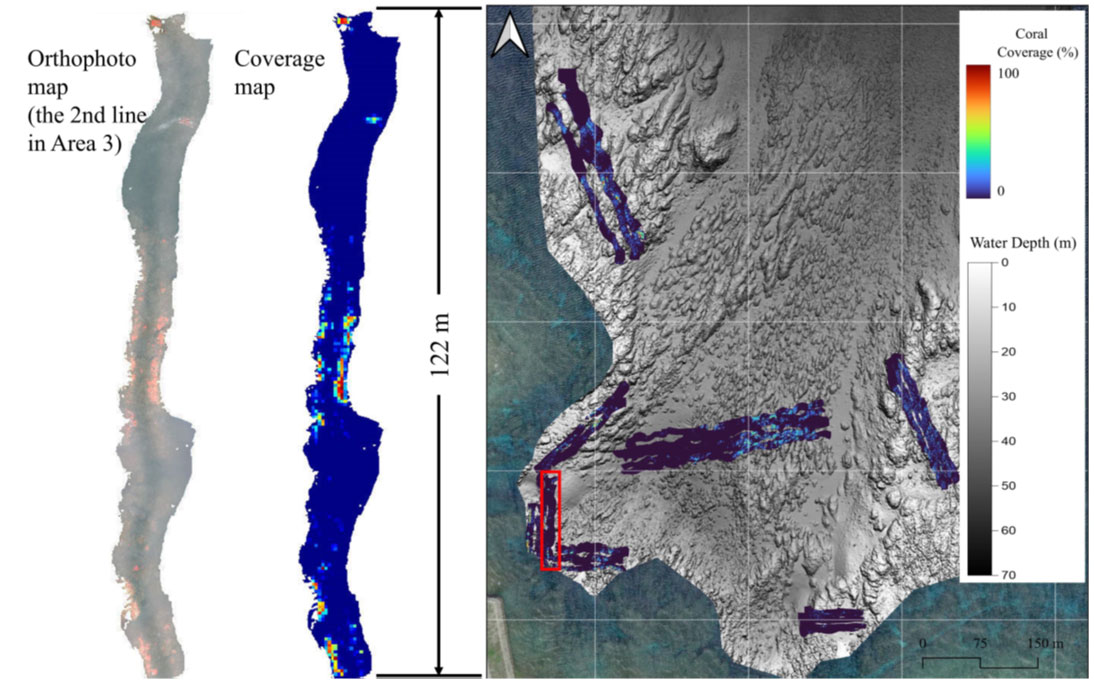
The Speedy Sea Scanner is a towed camera array system consisting of six underwater single lens reflex (SLR) cameras mounted on a dedicated frame. Towed behind a small vessel, this system rapidly captures continuous, high-resolution photographs of the seafloor, efficiently covering wide areas in a short time. Coral-Lab is a segmentation model that is "trained" using coral images collected from diverse marine regions worldwide, combined with historical and current images from the survey area. This enables the precise detection of coral. Traditionally, surveys have required observations by divers and other personnel. However, the new method allows swift and efficient wide-area topographic and coral distribution surveys. This contributes to the achievement of rapid and accurate marine environmental assessments.
MOL will continue identifying discharge points for deep seawater and establishing monitoring methods, thereby advancing the development of countermeasures proportionate to the impact on the marine environment.